
In China, mahjong is less a game you play to win than a social ritual: it is why a family that has run out of small talk still sits in the same room until midnight, played a little differently at every table.
In a Chinese home, the loudest sound is usually the happiest. Behind a closed door, a hundred and forty-four tiles are being stirred together with both hands — 手搓, the old way — and the racket that comes off the table sits somewhere between applause and rain on a tin roof. Then the tiles stop, four people sit down, and somebody says the four syllables that have ended more evenings than any curfew: 三缺一 — "three, short one." Three players is not a game. Three players is an invitation, aimed straight at whoever just walked in.
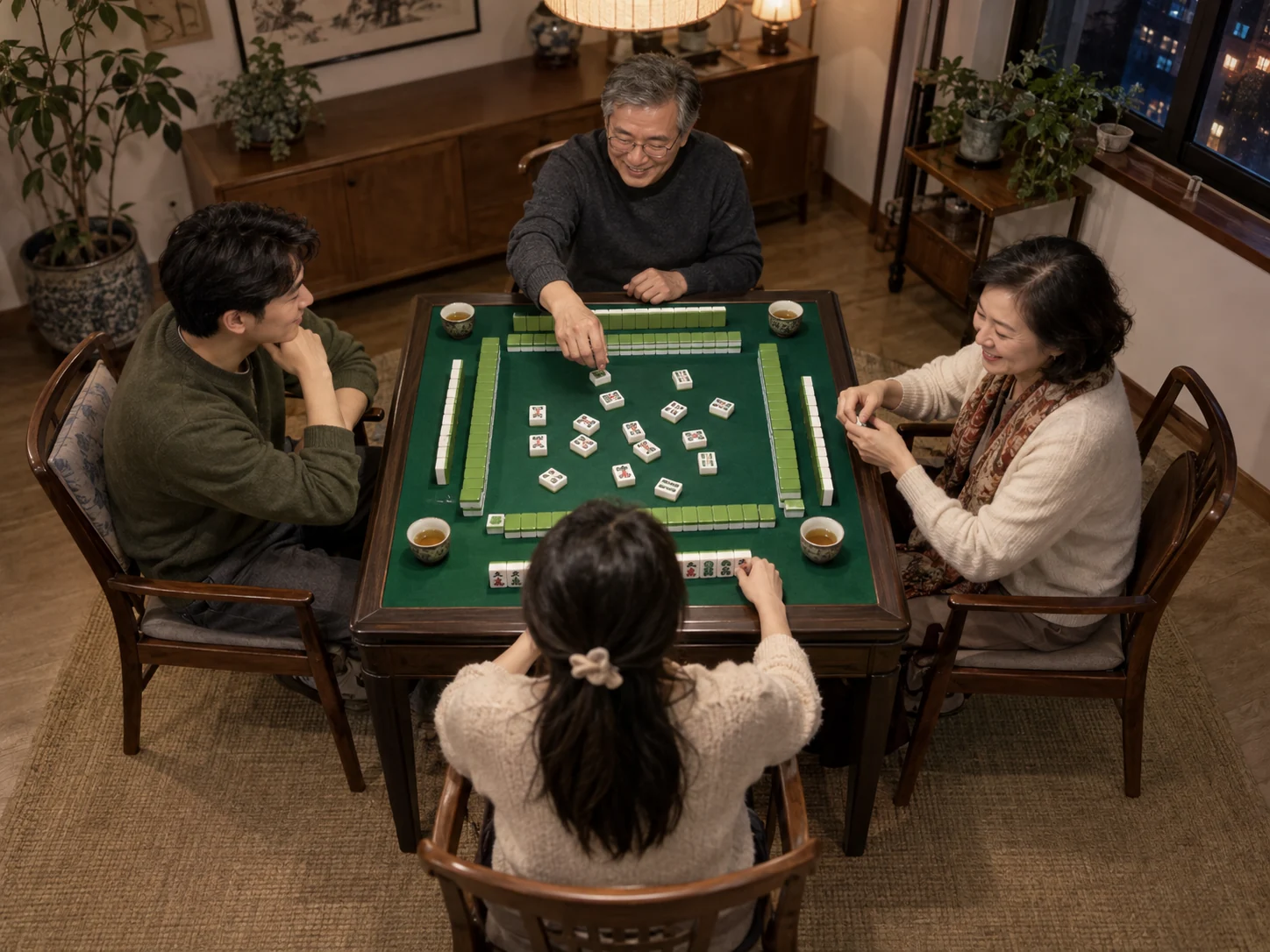
Why does the whole evening always end at the table?
The dishes get pushed to one end of the table; the rest is wiped clean. Somebody sets out tea, a plate of sunflower seeds, whatever fruit is in season — and then the table fills with the only thing anyone actually came for. Mahjong is less a hobby in China than a part of the day: what happens after dinner and after tea, the reason a family that has run out of small talk still sits in the same room until midnight. Watch an afternoon game and you notice how little of it is about winning. Somebody refills the tea. Somebody has been holding the same unlucky tile for six rounds and mentions it every single time.
Why does every table play by different rules?
Ask whether mahjong belongs to the south or the north and you get the same laugh everywhere: it is obviously theirs. The playing is where it turns local. Your province has a style, your city has a habit, and your family has a rule that exists only because a grandmother once decided it did. In Sichuan, the winning hand doesn't end the game — 血战到底, "fight to the bitter end," keeps everyone in their seat, including the person who just won and who now has to sit there and lose it back. The rules are announced, argued over, and settled before the first tile is drawn, and every table settles them differently. There is no official way to play at home — only your way.
“Mahjong is a game you can lose for six hours and still, walking home, call a very good evening.”
What changed when the machine arrived?
For most of its life the game began with work: you shuffled by hand, you stacked the wall by hand. Then the 自动麻将机 arrived, and now one player presses a button and four tidy rows of tiles rise up from the middle by themselves. Purists grumble that hand-shuffling is better for you; almost nobody misses the setup.
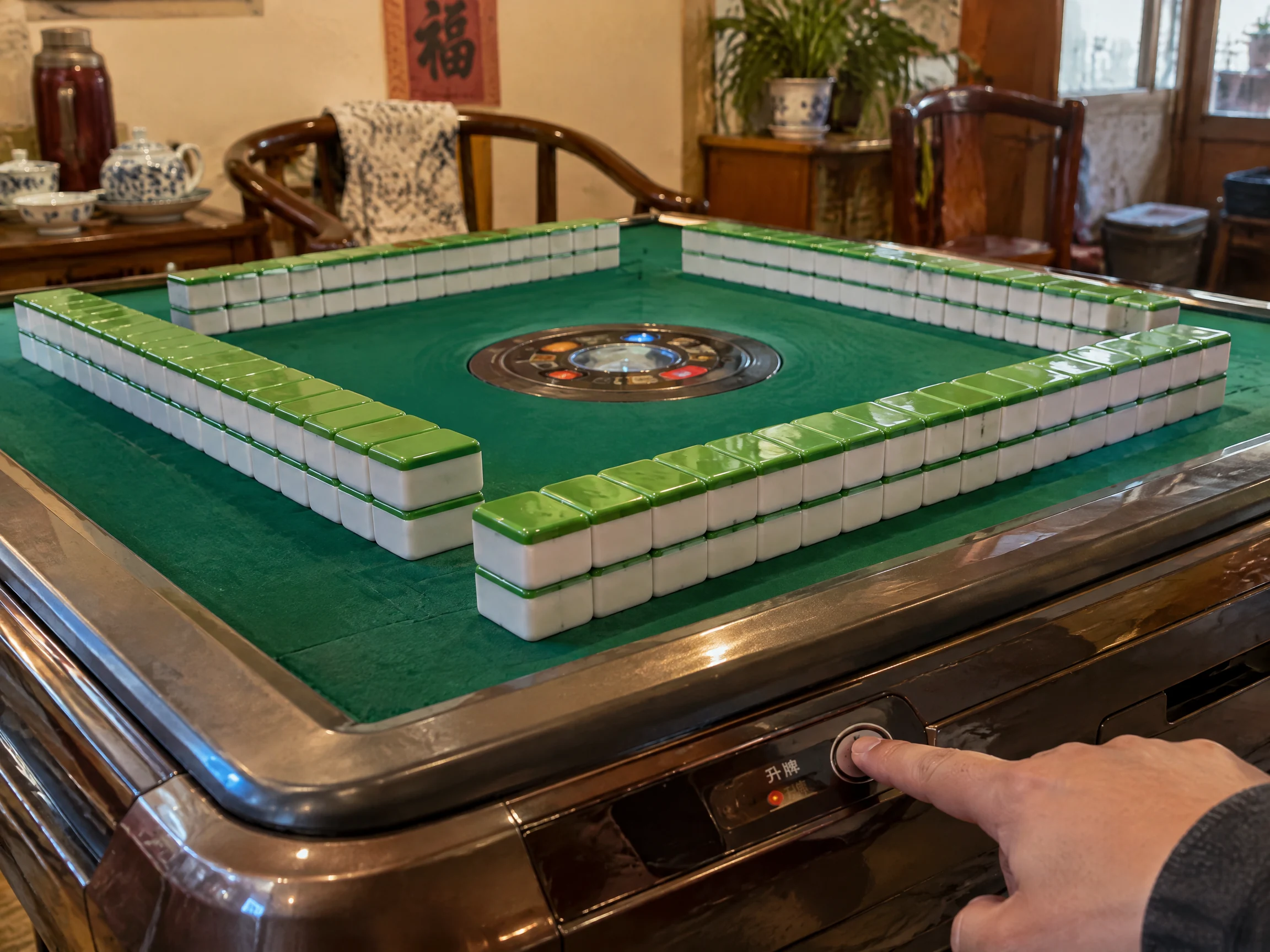
Another version of the evening may happen outside the home. Some Chinese cities now have self-service mahjong rooms: a group can book a private table on a phone and open the door with a code. Their prices and opening hours vary by place.
The table is the family
The people walking into those rooms are not the ones the cliché promised : students and young office workers, plenty of them born after 2000, who grew up watching a grandmother play and never expected to play themselves. They keep score in points instead of cash ; some tables settle the night with a round of milk tea for the winner. And when families move — across a province, across an ocean — the tiles move with them. Some sets are heirlooms, brought out the way other families bring out the good china ; in a Chinatown apartment or a far suburb, the same four sounds come back : shuffle, draw, discard, clack. Money still changes hands at plenty of tables, and at a few it does real damage. But the money is rarely the point. It is the language a grandmother and a teenager can share without translating — and a reason to stay until midnight.
The tiles go back in the box. Somebody, already at the door, turns around and says 最后一局 — "one last round" — a phrase that has never once meant what it said.
Key facts
- A standard set has 144 tiles, and the classic game is for four players, one to each wind: East, South, West, North.
- The automatic mahjong table now does the setup in a single button press — it shuffles, stacks, and deals.
- Self-service mahjong rooms offer another place for friends to gather; prices and hours vary.
- Most family games keep score in points, not cash — the money is rarely the point.
FAQ
Is mahjong gambling?
Not in most homes. Family tables often keep score in points rather than cash, though money does change hands at plenty of tables, and at a few it does real damage.
How many tiles are in a mahjong set, and how many people play?
A standard set has 144 tiles. The classic game is for four players, each representing a wind — East, South, West, and North.
What does 三缺一(sān quē yī)mean?
"Three, short one" — the call for a fourth player. Three people is not a game; it is an invitation aimed at whoever just walked in.
Why does every family play mahjong differently?
There is no single official rule set. Your province has a style, your city has a habit, and your family has a rule that exists only because a grandmother once decided it did. In Sichuan, 血战到底 keeps everyone in their seat.
Words to know
- 麻将 má jiàng — mahjong
- 手搓 shǒu cuō — to shuffle and stack the tiles by hand
- 三缺一 sān quē yī — "three, short one": the call for a fourth player
- 碰 / 杠 / 胡 pèng / gàng / hú — claim a triplet / claim all four / win the hand
- 血战到底 xuè zhàn dào dǐ — Sichuan "fight to the bitter end" rules
- 自动麻将机 zì dòng má jiàng jī — the automatic mahjong table
- 自助麻将房 zì zhù má jiàng fáng — self-service, staffless mahjong room
- 最后一局 zuì hòu yī jú — "one last round"
Sources and further reading
- People's Daily reporting on young people gathering around mahjong in shopping centers: https://paper.people.com.cn/zgjjzk/pc/content/202607/15/content_30179896.html
- People's Daily reporting on mahjong clubs among young Chinese Americans: https://usa.people.com.cn/BIG5/n1/2024/0603/c241376-40248908.html

