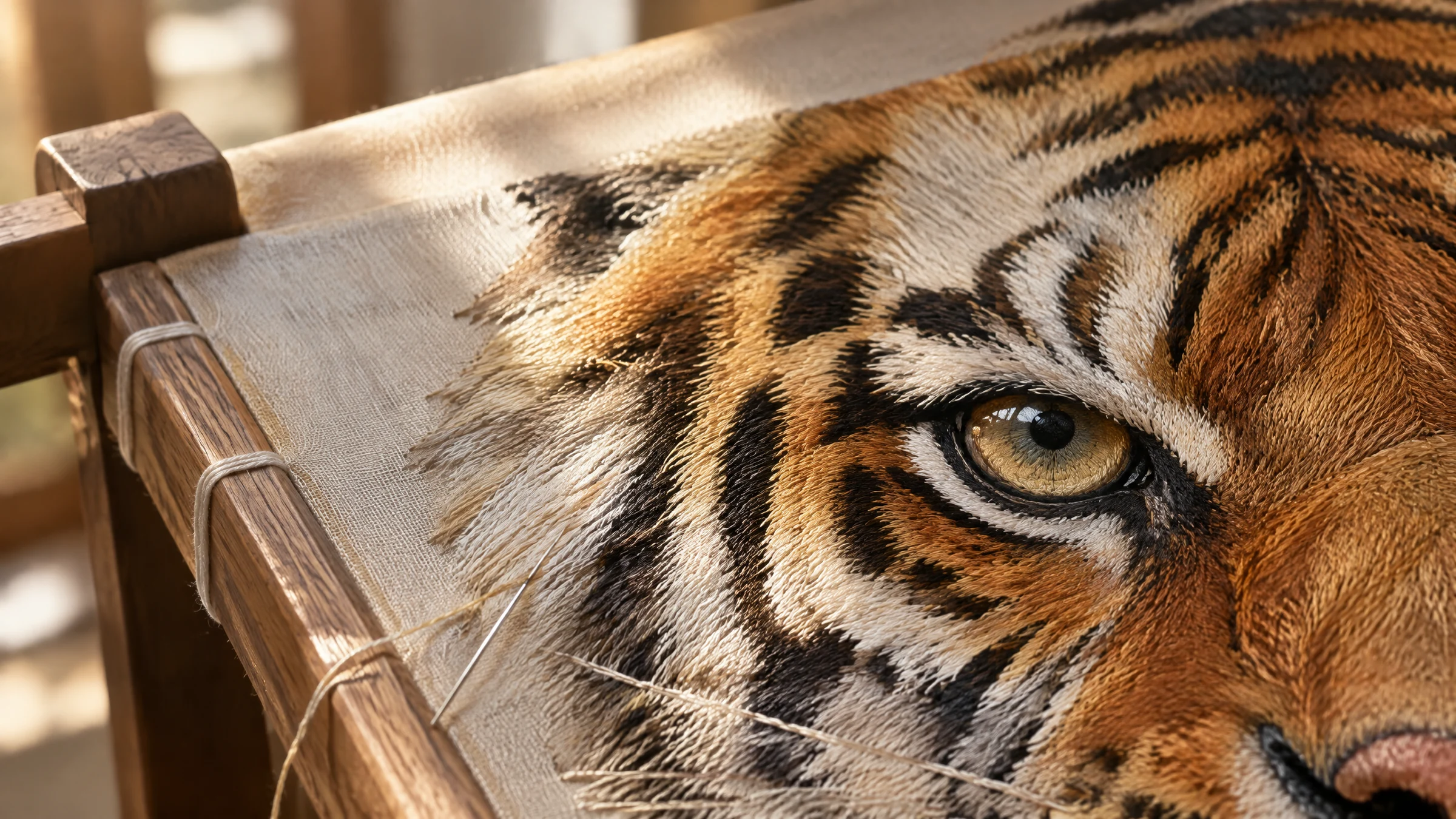
The tiger is a memorable face of 湘绣 (Xiāng xiù), Hunan's embroidery tradition, because its makers learned to make fur seem to lift from silk. Look closely at the eye: many shades of thread create the impression of an animal looking back. Yet the same patient craft can make flowers, birds and quieter scenes; the tiger is an invitation into Xiang embroidery, not its whole identity.
What makes Xiang embroidery different?
Xiang embroidery is one of the four great embroideries of China, a group called 四大名绣 — “the four famous embroideries.” Their histories and techniques differ. Looking at their animal subjects, I find Hunan's work especially vivid; that is an impression, not a ranking of the four traditions. Xiang embroiderers also make flowers, landscapes and portraits with delicacy as well as force. In the workrooms of Shaping, on the northern edge of Changsha, a tiger is being made one thread at a time. It is not a big animal yet—a shoulder, an ear, the curl of a lip. But the eye is done, and the eye is the trouble. Wherever you stand in the room, it seems to be looking back at you. Where the others give you the garden, Xiang gives you the animal. Its signature subject is the 狮虎 — “the lion and the tiger”; its temperament, in Chinese, is 雄浑写实 — “bold, and true to life.” There is a saying among embroiderers that captures the difference in four characters: 苏猫湘虎 — “Su cats, Xiang tigers.” In most embroidery, an animal rendered in thread looks polite. In Xiang, it looks like it might move.
In most embroidery, an animal in thread looks polite. In Xiang, it looks like it might move.
How does a stitched tiger look alive?
What makes a stitched tiger look alive is not the outline. It is the fur—and the fur is the invention.
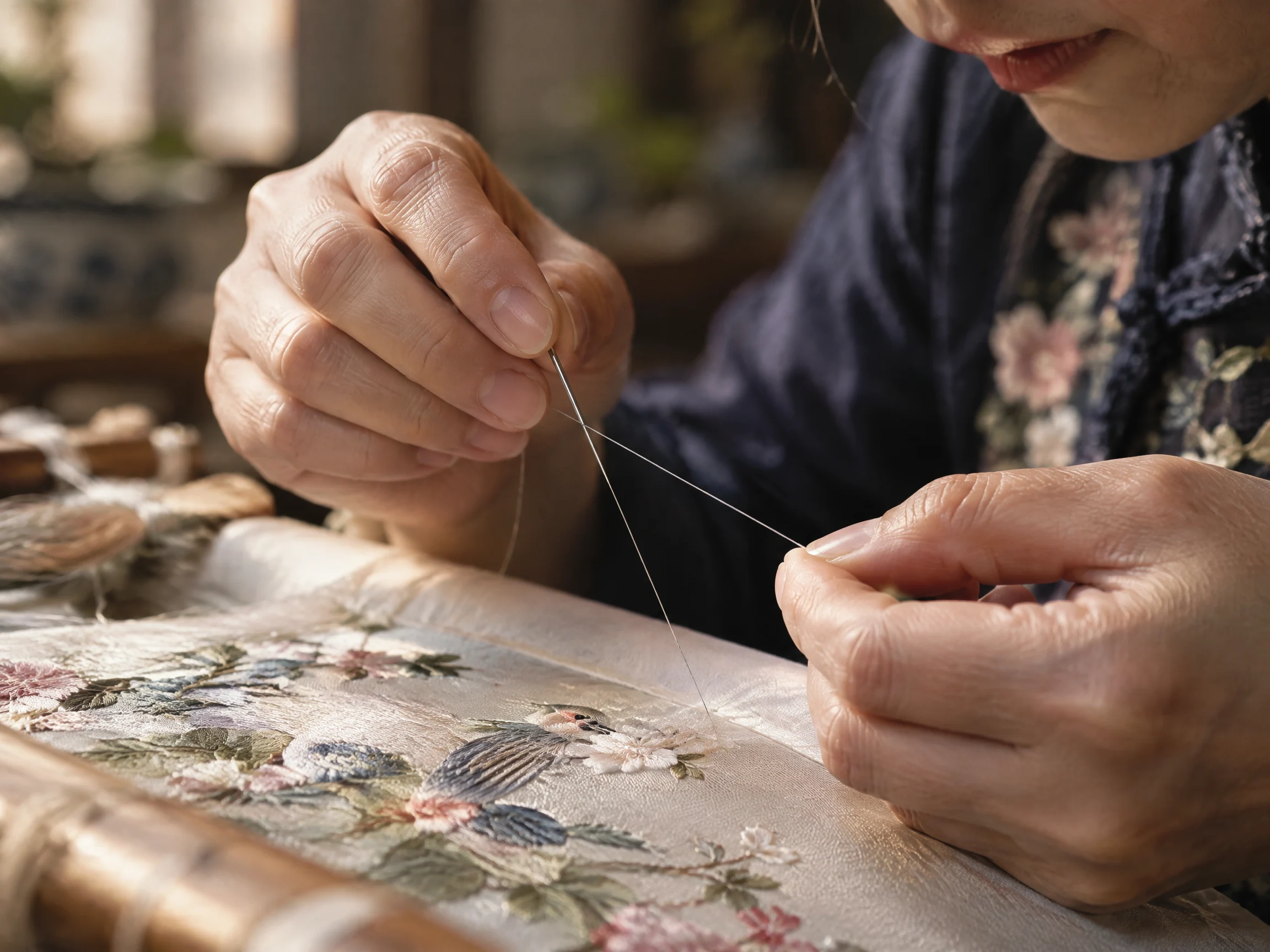
By the mid-twentieth century, the Hunan embroiderer Yu Zhenhui had perfected 鬅毛针 — “the fluffy stitch.” Ordinary embroidery lays thread flat, so a coat reads as smooth as ribbon. 鬅毛针 does the opposite: it sets each strand slightly away from the surface, working with the nap of the silk so the fur stands up into the light. Move your eye across a Xiang tiger and the coat shifts as you go—deep where it turns away, bright where it catches—the way real fur does. The tradition counts dozens of stitches, each with a job to do. This one exists for the sake of hair.
How can one silk hold two different pictures?
Then there is the trick that visitors, shown it for the first time, tend to call magic.
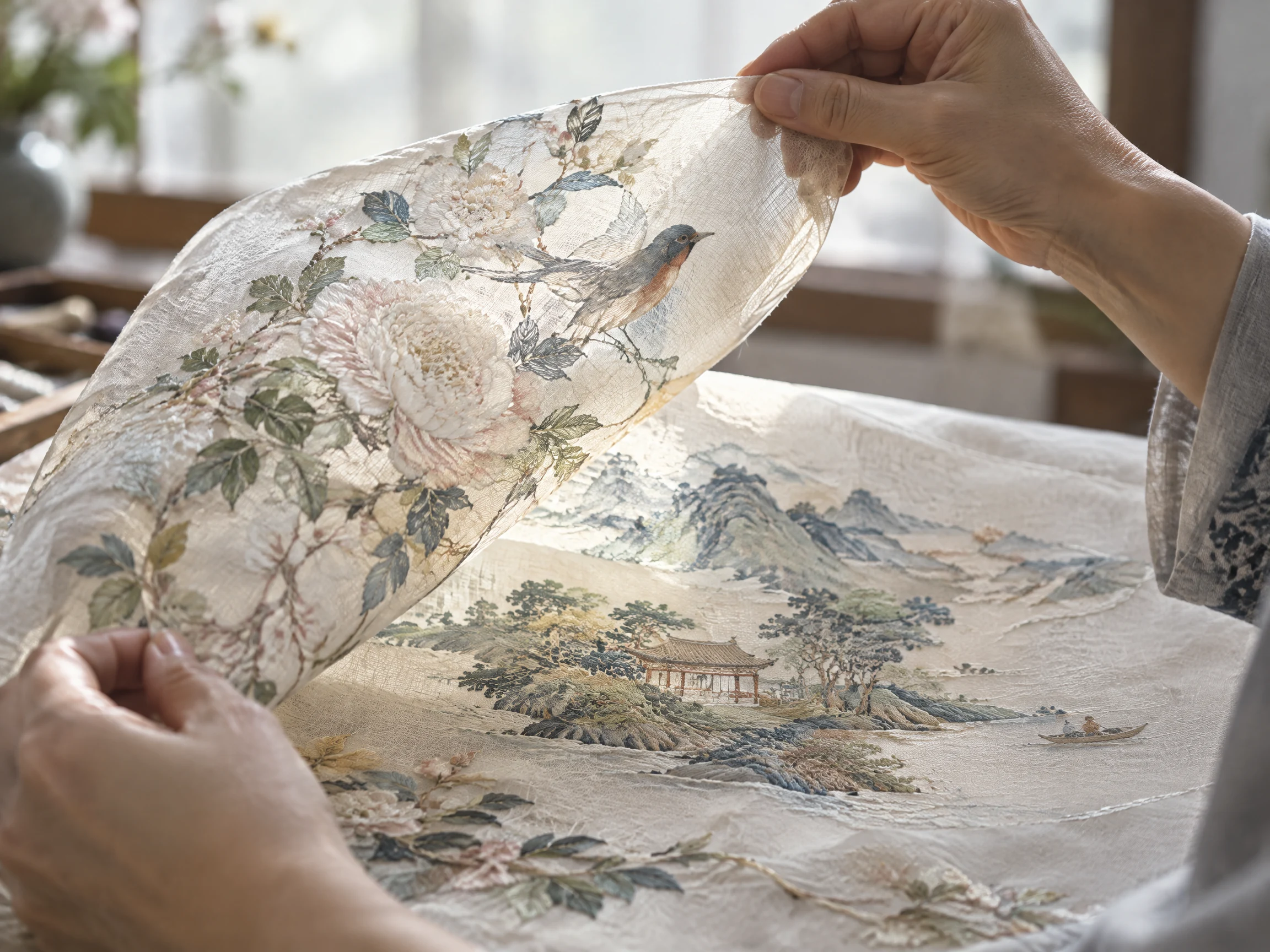
Take a single sheet of silk—for this it must be fine enough to be almost transparent. Embroider a tiger on the front. Turn it over. There is no back: there is a second picture, entirely different, worked so that not one knot, loose end, or crossing thread gives it away. Both sides are the front. The craft calls this 双面全异绣 — “double-sided, all-different embroidery”—a demanding form that invites you to look from both sides.
What it costs
None of this is quick. A single panel can take months; the great pieces take years, a square inch of coat holding more stitches than you would guess. And the price is paid in a currency the craft rarely mentions: eyesight. To get the soft gradients, the silk is split—劈丝 — “the splitting of a thread”—one strand pared down into fibers finer than a human hair, stitched under a light that has to fall just so. It is not delicate work. It is patient work, and it wears people out.
A craft that travels
Xiang embroidery is old, but it was never only local. Some of its earliest threads were pulled from Warring States tombs in Changsha and from the Han-dynasty grave at Mawangdui—stitching more than two thousand years old, found a short drive from the workrooms of today. By the late Qing, Shaping had earned a name for the craft, with a line still quoted today: 家家有绣女,村村有能手 — “every household a needlewoman, every village a master.” In 1933, a Changsha studio embroidered a portrait of the American president Franklin D. Roosevelt, an early sign that this very local craft could cross an ocean. And in 2006 the state named Xiang embroidery a national intangible cultural heritage, which is a formal way of saying: this is not allowed to disappear.
Why the tiger matters
You could stand in front of a Xiang tiger for a long time before noticing the labor in it—that the whiskers are not hairs but stitches, that the eye holds many shades, that the seam you keep looking for is not there. The craft hides much of its labor so that the subject, whether animal or flower, can hold your attention. Changsha, the city that wakes up to bowls of rice noodles, keeps this quieter discipline too. In one room, breakfast comes out of a steel pot in ten minutes. In another, a tiger takes a year. Both are how the place says it—one in broth, one in silk: you are welcome here.
Key facts
- What it is: 湘绣, the embroidery of Hunan, centred on Changsha — one of China's four great embroideries, alongside Suzhou, Guangdong and Sichuan.
- Its signature: lions and tigers, worked in the 鬅毛针 “fluffy” stitch, which lifts the fur into the light.
- One demanding form: 双面全异绣, a single sheet of silk carrying two entirely different pictures, with no knot or loose end to give it away.
- Its standing: named a national intangible cultural heritage in 2006, and the traditional heart of the craft is Shaping, on Changsha's northern edge.
- Its pace: a single panel can take months; the great pieces take years.
FAQ
Is Xiang embroidery the same as Su embroidery? No. Both belong to China's four great embroideries and each includes varied subjects and techniques. The saying 苏猫湘虎 — “Su cats, Xiang tigers” — points to famous animal subjects, but it does not describe every work made in either tradition. What is 鬅毛针? "The fluffy stitch," refined by the Hunan master Yu Zhenhui by the mid-twentieth century. Instead of laying thread flat, it sets each strand slightly away from the surface so the fur stands up into the light. What is 双面全异绣? “Double-sided, all-different embroidery”: one sheet of fine silk with two different pictures, one on each side, and no knot or loose end to betray it. Where can you see Xiang embroidery? Around Changsha, above all in the Shaping area on the city's northern edge, the traditional heart of the craft — and in the collections of the Hunan Xiang Embroidery Museum. Why the tiger? Because the tiger is a memorable test of how thread can suggest fur, movement and a living gaze. It is one celebrated subject, not a definition of the entire craft.
Words to know
- 湘绣 xiāng xiù — Xiang embroidery, the embroidery of Hunan
- 四大名绣 sì dà míng xiù — the four great embroideries : Su, Yue, Shu, Xiang
- 狮虎 shī hǔ — the lion and the tiger, Xiang's signature subjects
- 雄浑写实 xióng hún xiě shí — “bold, and true to life”
- 鬅毛针 péng máo zhēn — the “fluffy stitch,” made for fur
- 双面全异绣 shuāng miàn quán yì xiù — one silk, a different picture on each side
- 劈丝 pī sī — splitting a silk thread finer than a hair
- 苏猫湘虎 sū māo xiāng hǔ — “Su cats, Xiang tigers”
Sources and further reading
- Wikipedia, "Xiang embroidery": https://en.wikipedia.org/wiki/Xiang_embroidery
- Hunan Intangible Cultural Heritage database, “湘绣” — national list, first batch, 2006: http://www.hunanfeiyi.cn/CulturalInfo-122-1.html
- China Daily, "China in stitches: The Four Great Embroideries," 2026: https://global.chinadaily.com.cn/a/202605/11/WS6a014547a310d6866eb47e6b.html
- China Federation of Literary and Art Circles, “湘绣”: https://www.cflac.org.cn/gymssy/ctgymsml/cxzmrz/201305/t20130529_193581.html
- Hunan Online, “一幅罗斯福绣像 让湘绣誉满全球”: http://hunan.voc.com.cn/news/201607/26675852.html