Here is a piece of travel advice nobody gives you before Zhangjiajie: leave room for rain.
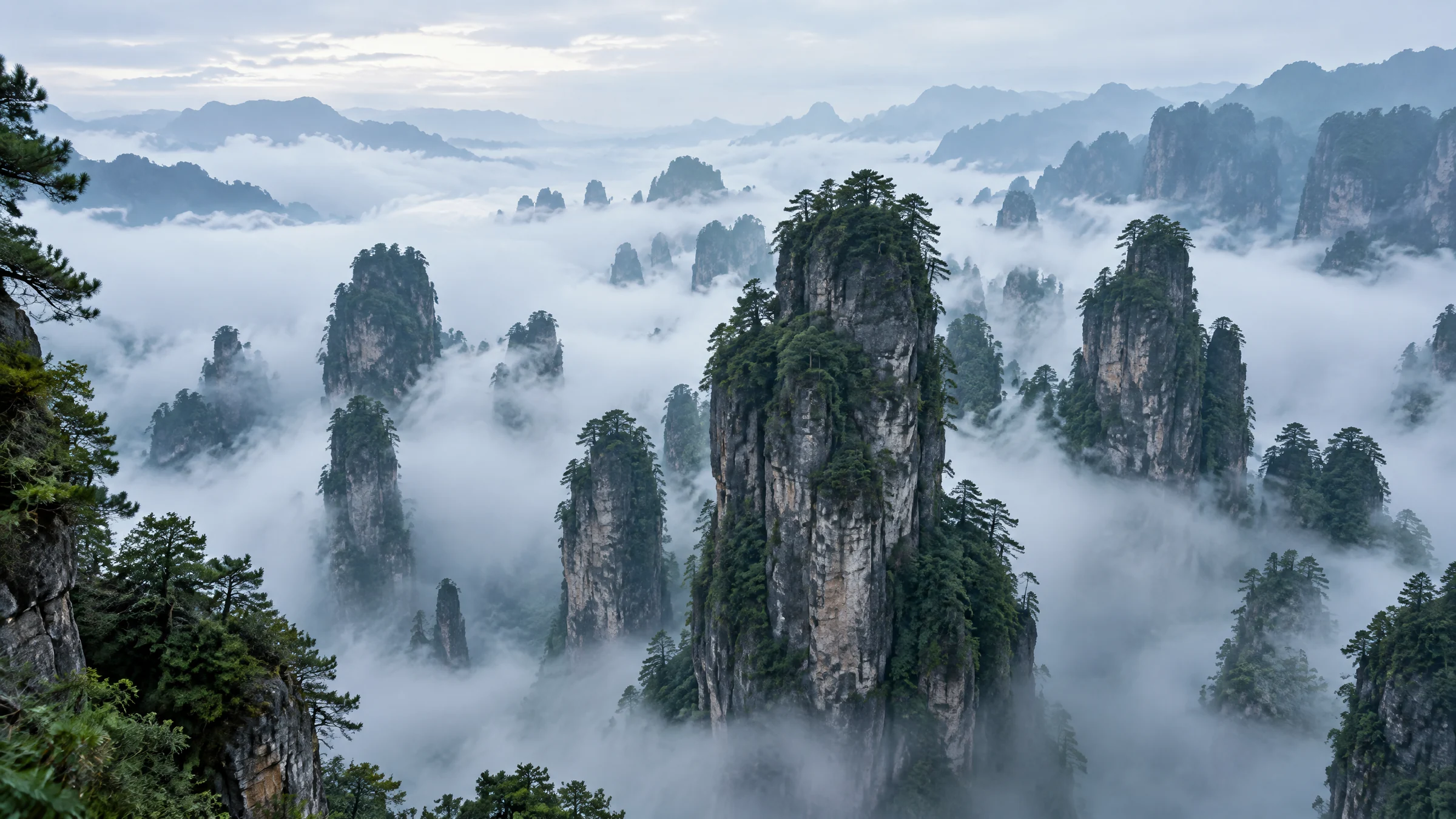
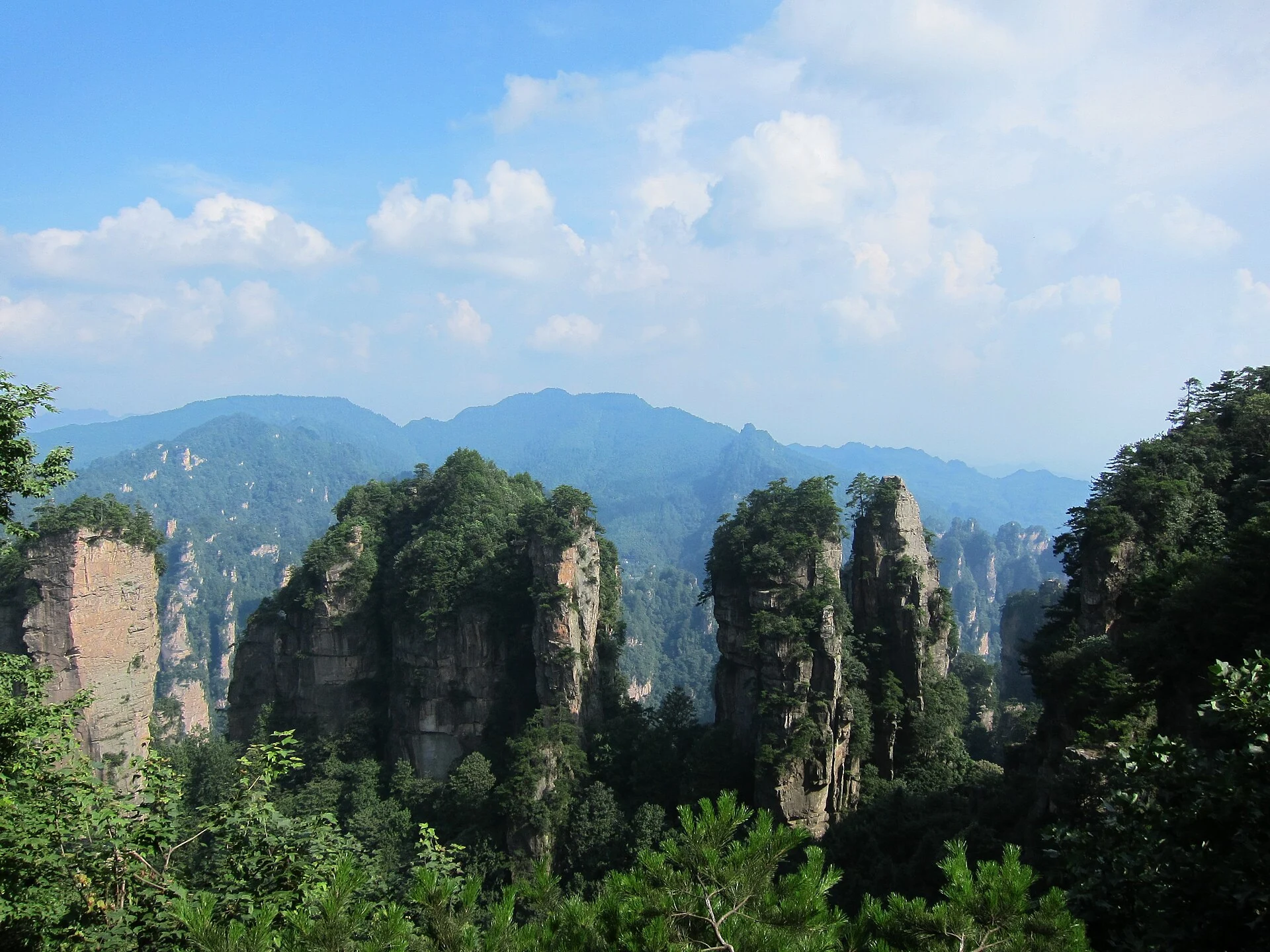
On a clear day the mountains are a postcard—spectacular, legible, and somehow smaller than you expected, because you can see so many of them at once. On a misty day they disappear. Then, as the cloud moves, the summits return without their bases. They seem to float.
Zhangjiajie lies in northwestern Hunan, where the Wulingyuan landscape refuses to fit neatly into a photograph. UNESCO describes more than 3,000 narrow quartz-sandstone pillars and peaks, many rising more than 200 metres. They stand among ravines, streams, caves and forest. It is enough stone to fill a horizon, yet a low cloud can make almost all of it vanish.
Why they float
What makes the pillars float is not the rock. It is the weather.
Mist settles into the valleys and hides the lower slopes, leaving the summits like islands in the air. The Chinese phrase 云海—"a sea of clouds"—gets closer to the feeling than a photograph does. On a grey morning the mountains you came for may be simply gone. Then the wind shifts, and they return a few at a time, the way a mountain might if it were being painted.
There is no promise that rain will produce this view on command. Cloud can close the scene completely, or lift before you reach a lookout. That uncertainty is part of being here. The landscape does not hold still for the camera.
The painting is not a metaphor
Chinese landscape paintings can look dreamlike to someone who has never stood among such peaks: dark silhouettes, ridges fading into one another, empty space doing as much work as the rock. A wet day in Zhangjiajie makes that visual language feel less remote. Cloud and light give the mountains an ink-like edge, then take it away.
The scrolls and the mountain can seem like the same image—and the mountain came first.
Look for a moment longer and the edges change again. What seemed like blank space between two peaks becomes the place where the next ridge begins to appear.
You don't just look at it
The second surprise is how you visit. Viewpoints matter, but so does the journey between them. Follow Golden Whip Stream at the valley floor and the cliffs rise above the path. Higher up, stairs, cliffside walks, cableways and the Bailong Elevator change the scale again. The elevator climbs 326 metres; suddenly a peak you had been looking up at can be beneath you.
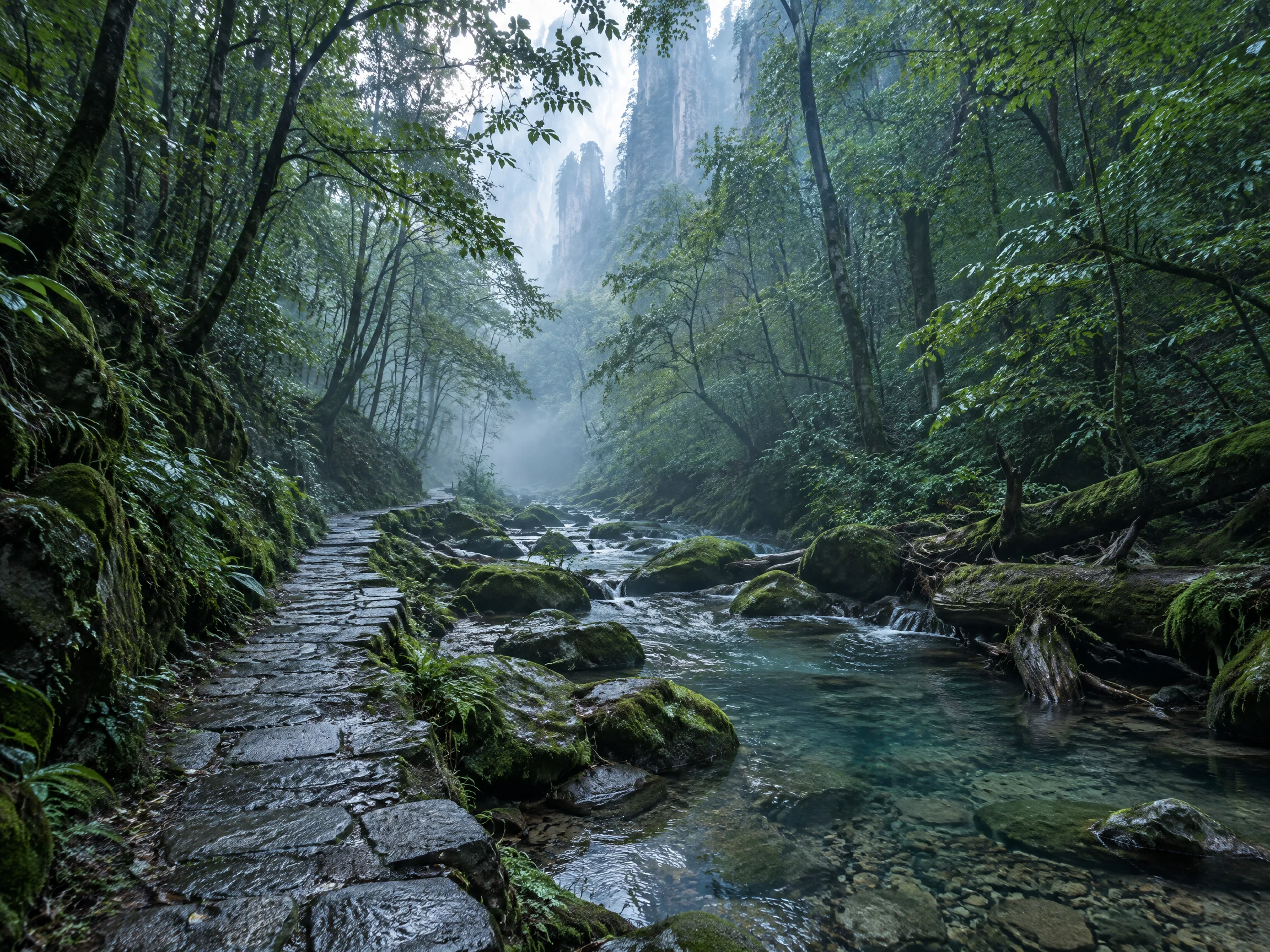
There is pleasure in that change of position. The forest sounds different below the pillars. At the top, a break in the mist reveals paths and trees you could not see from the valley. This is not scenery you observe from one fixed spot. It is terrain you enter, leave, and enter again from another height.
Tianmen Mountain, nearer the city, offers another kind of ascent, with a great natural opening in the cliff and steps leading toward it. It is a separate landscape, not another name for Wulingyuan. Together they make a visit to Zhangjiajie feel less like collecting one famous view and more like learning how to move through a mountainous place.
The place the world came to see
The rock is old; its international fame is comparatively new. In 1979 the painter Wu Guanzhong visited the forest. His essay about this then little-known landscape appeared the following year and helped bring it to a wider Chinese audience. Zhangjiajie became China's first national forest park in 1982. The wider Wulingyuan area joined UNESCO's World Heritage List in 1992, and in 1994 the city changed its name from Dayong to Zhangjiajie.
The name travelled farther through photographs and comparisons with the floating mountains of *Avatar*. But the landscape is more than a film reference. It is also a place where residents work, where guides and drivers help visitors find their way, and where protecting a celebrated natural area must coexist with the lives and livelihoods around it.
Come for more than the photograph
A clear blue day can give you the picture you expected. A cloudy one may give you something less certain and more memorable: peaks appearing and vanishing like ships in fog. Neither day is the only true Zhangjiajie.
You came for a view; you may leave remembering what it felt like to move inside one.
Words to know
- 云海 yún hǎi — "sea of clouds"
- 石英砂岩峰林 shíyīng shāyán fēnglín — quartz-sandstone peak forest
- 百龙天梯 Bǎilóng tiāntī — Bailong Elevator, the cliffside lift
- 大庸 Dàyōng — the city's former name
Sources and further reading
- UNESCO World Heritage Centre, Wulingyuan Scenic and Historic Interest Area: https://whc.unesco.org/en/list/640
- Hunan Provincial Forestry Department, history of Zhangjiajie National Forest Park and Wu Guanzhong's visit: https://lyj.hunan.gov.cn/tslm_71206/slly/slgy/201512/t20151227_2587631.html
- Hunan Provincial Government, city renaming and tourism history: https://www.hunan.gov.cn/hnyw/zwdt/201812/t20181212_5233170.html
- Hunan Provincial Department of Culture and Tourism, Bailong Elevator dimensions: https://whhlyt.hunan.gov.cn/whhlyt/english/Tourism/Recommendations/202211/t20221121_29132887.html