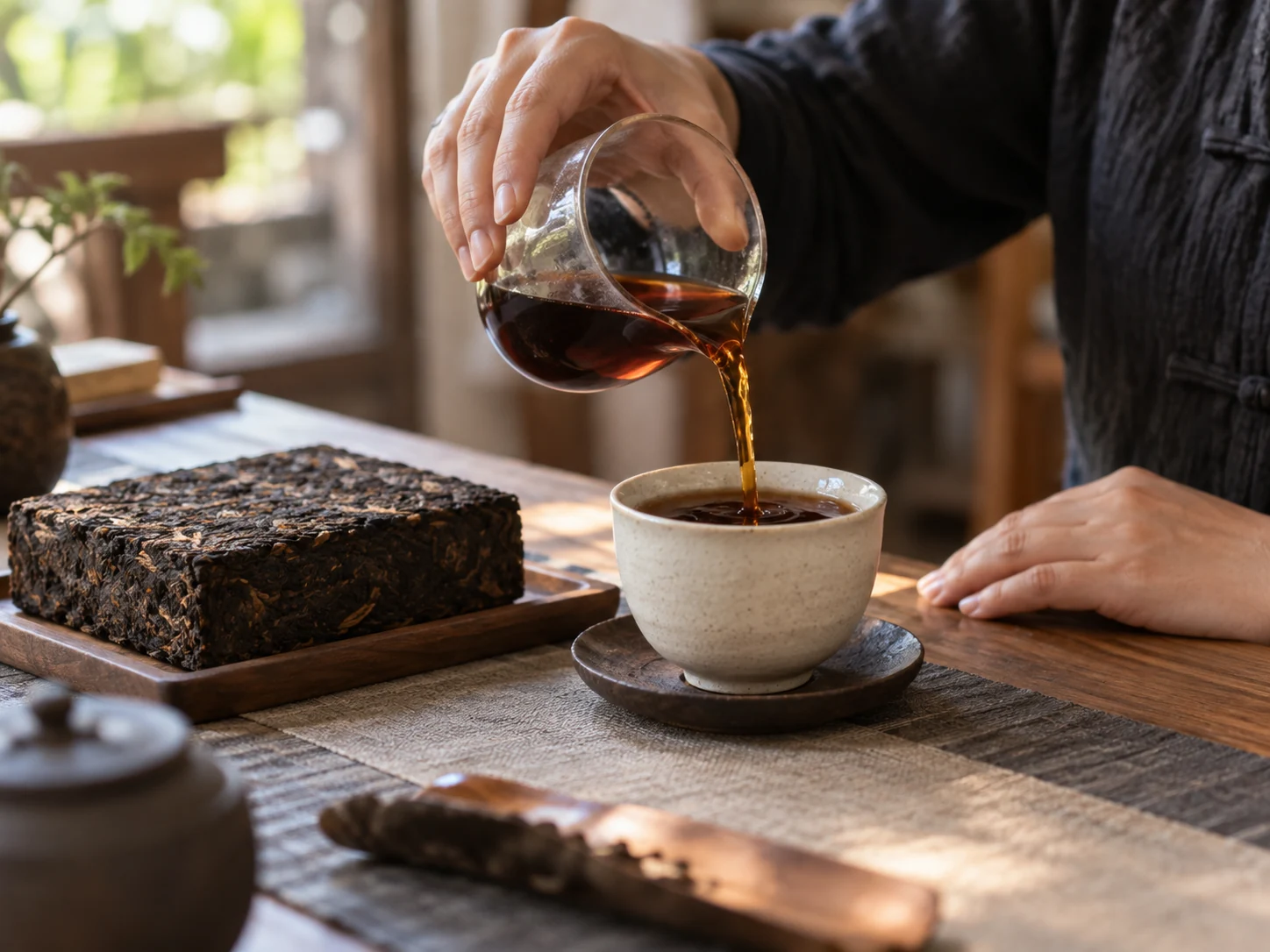
Some teas are made to be opened quickly. Anhua dark tea carries the shape of distance. It is a post-fermented tea from Anhua County, in Hunan — and its most recognizable forms, the pressed brick and the bamboo-wrapped column, were shaped less by fashion than by the long roads the tea had to travel toward northwestern China. In Chinese tea classification, heicha means "dark tea": tea that undergoes microbial transformation after its initial processing. It is not what English speakers usually call black tea, known in Chinese as hongcha, or "red tea." Anhua's bricks and bamboo-wrapped columns make that distinction tangible: these are forms shaped by work, storage and travel.
Key facts
- What it is: a post-fermented dark tea, heicha, from Anhua County, Hunan.
- Signature forms: pressed bricks and tall bamboo-wrapped columns. A qianliang cha, or "thousand-liang tea", can be about 1.5 metres high and roughly 36 kg; dimensions vary.
- Why the shape: compressing the leaves made tea easier to store, count and carry over long land routes.
- "Golden flowers": visible fungal growth associated with some properly made brick teas. Their presence alone is not a medical or quality guarantee.
Why does the tea come pressed and wrapped?
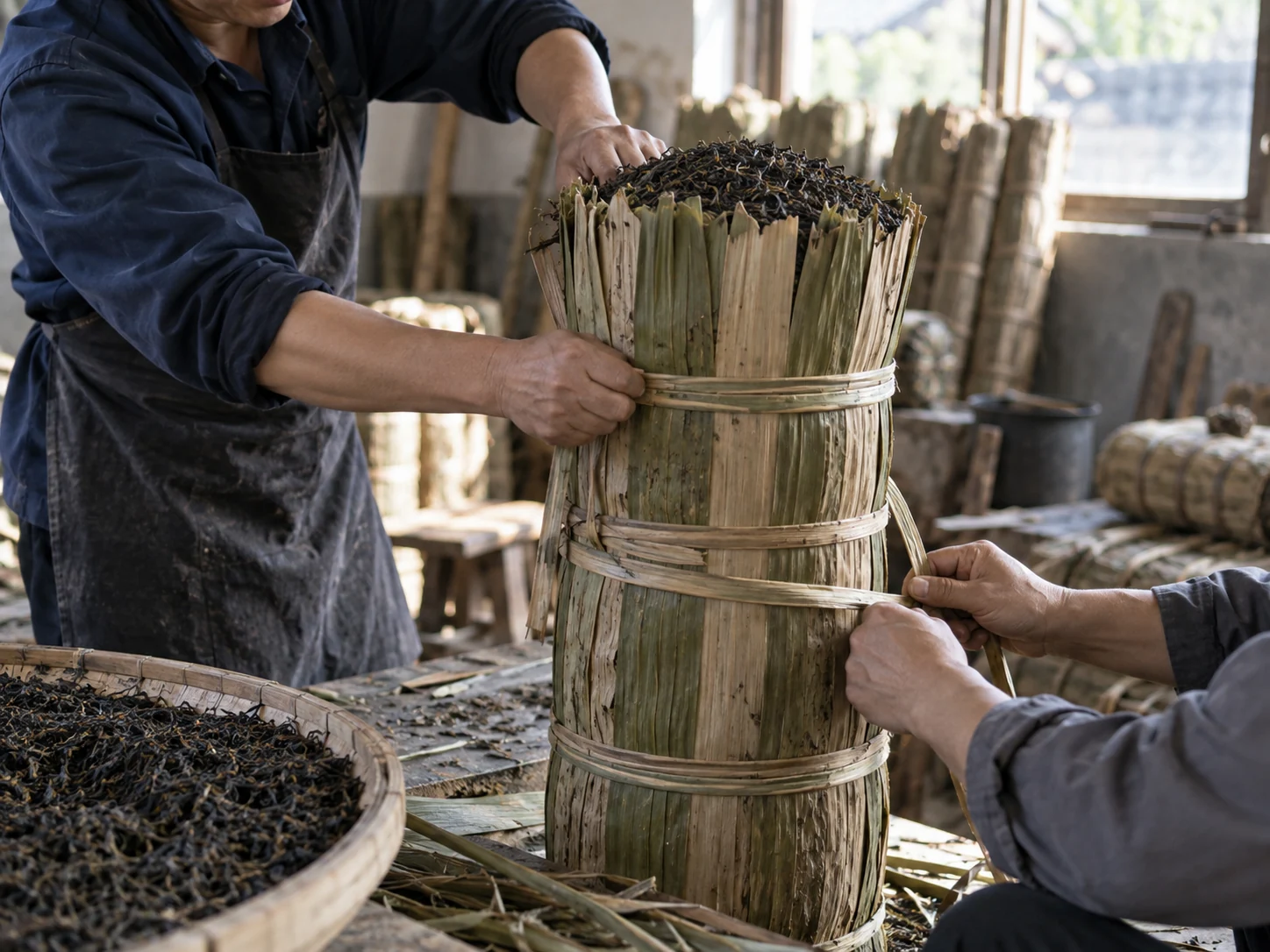
Loose leaves take up space and can be difficult to move over long distances. Compressing tea made it more practical to store, count and transport. Over time, Anhua became connected to trading routes — later known as the Ten-Thousand-Li Tea Road — that carried tea through inland China and toward northwestern markets, and on toward the Russian border. The journey affected the product itself. Tea was not made in isolation and then placed into history afterward. The need to move it, protect it and sell it helped determine its shape and processing.
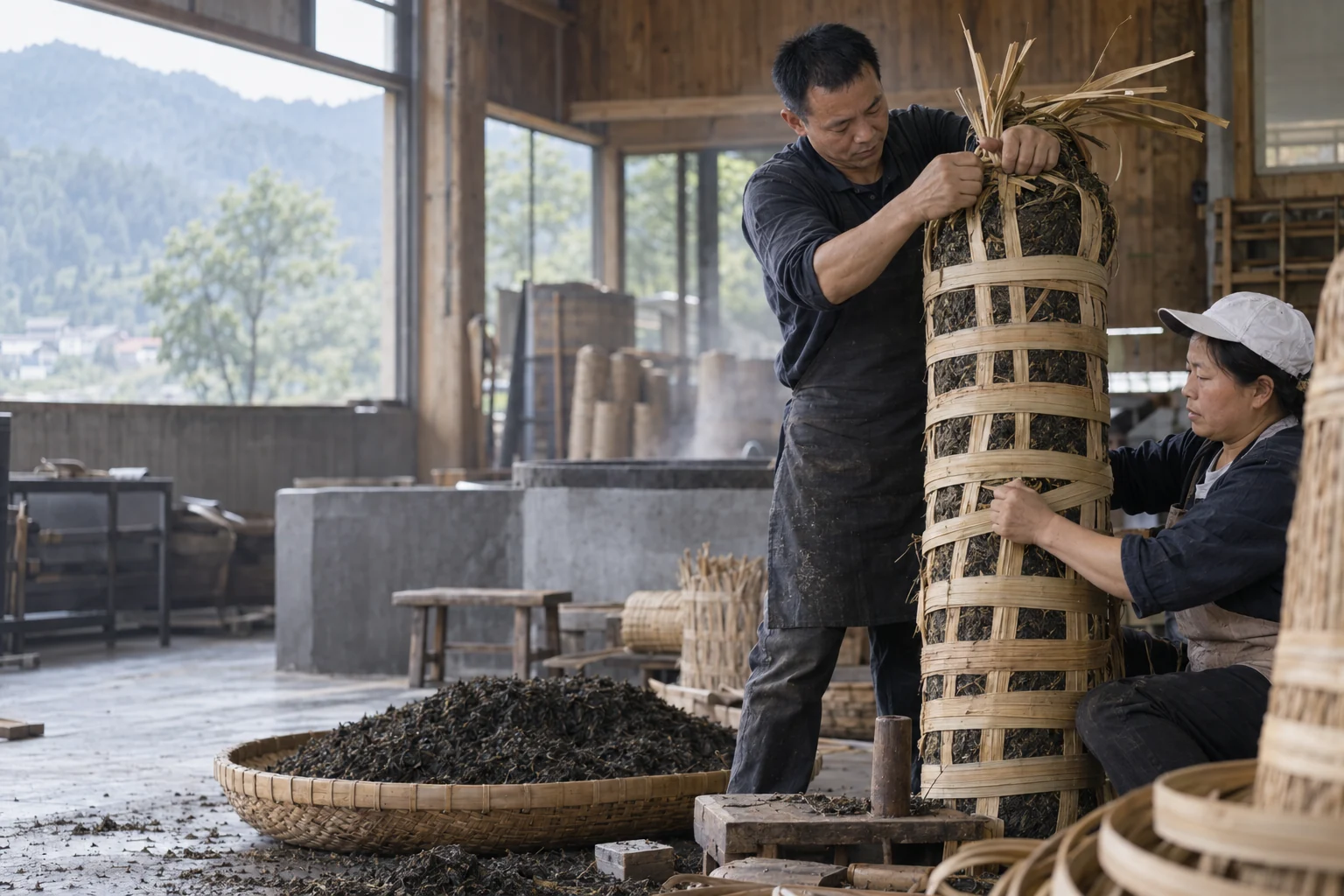
One of Anhua's most striking forms is qianliang cha, commonly translated as thousand-liang tea. The tea is compressed into a tall cylindrical package using bamboo and other plant materials. Its making requires coordinated physical work: filling, tightening, rolling and repeatedly pressing the column until it becomes dense and even. The finished object can stand like a narrow pillar, roughly 1.5 metres tall and about 36 kilograms in weight. It is both tea and evidence of a transport technology.
What does fermentation actually change?
Dark tea is often described only by its age. Age matters, but it is not a guarantee of quality, and older is not automatically better. Processing, storage, moisture and the condition of the original leaves all influence what happens over time. Some Anhua brick teas show small golden-colored points associated with fungal growth inside the tea. This feature is commonly called "golden flowers," but its presence alone is not a health or quality guarantee. For a reader tasting Anhua dark tea for the first time, the more useful questions are simple: How was this tea made? How was it stored? Who drinks it, and with what food? What changes from the first infusion to the last?
A Hunan story that travels beyond Hunan
Anhua dark tea is one of Hunan's cultural signatures, but its story has never stayed within the province. Its history includes growers in mountain communities, processors who learned to control heat and moisture, merchants who organized long-distance trade, and drinkers living far from the place where the leaves grew. That makes it a fitting story for Stay for Chinese Tea. A cup can begin in one landscape and become meaningful somewhere else. Today, Anhua dark tea is also part of a modern local industry involving factories, museums, tourism and branded products. The challenge for a cultural story is to see both sides: the inherited knowledge and the contemporary economy, the impressive tea object and the people whose work gives it form. The next time a bamboo-wrapped column appears in a shop or exhibition, it is worth looking beyond its unusual size. Its shape answers an old practical question: how can tea survive a long road?
A clear answer
Anhua dark tea is a post-fermented tea tradition from Anhua County, Hunan. Its compressed bricks and bamboo-wrapped forms developed in connection with processing, storage and long-distance trade, linking Hunan tea-making communities with drinkers across inland and northwestern China.
FAQ
Is Anhua dark tea the same as black tea? No. In the Chinese classification it is heicha — "dark tea," a tea that undergoes microbial transformation after its initial processing. What English calls "black tea" is, in Chinese, hongcha, "red tea." What is qianliang cha? "Thousand-liang tea," also called huajuan cha, "flower-roll tea": tea pressed into a tall, bamboo-wrapped column, roughly 1.5 metres high and about 36 kilograms — long enough to stand like a pillar. What are the "golden flowers"? Small golden points associated with fungal growth in some brick teas. Their identity and significance should be checked for a particular tea; they are not a medical claim. Does older mean better? Not automatically. Age matters, but quality also depends on how the tea was processed, how it was stored, and the condition of the original leaves. How is it drunk? Brewing practices vary. Try a small amount across several infusions and notice how the cup changes; follow the producer's guidance for the tea you have.
Words to know
- 黑茶 hēichá — "dark tea": a category of tea that undergoes microbial transformation after processing
- 红茶 hóngchá — "red tea": what English calls black tea
- 安化黑茶 ānhuà hēichá — Anhua dark tea, from Anhua County, Hunan
- 千两茶 qiānliǎng chá — "thousand-liang tea"; also called 花卷茶 huājuǎn chá, "flower-roll tea": the tall bamboo-wrapped column
- 金花 jīnhuā — "golden flowers": small golden points associated with fungal growth inside some brick teas
- 万里茶道 Wànlǐ Chádào — the "Ten-Thousand-Li Tea Road" : the trade route that carried Anhua tea north toward the Russian border and beyond
Sources and further reading
- Hunan Provincial Government service portal, "Anhua Dark Tea": https://zwfw-new.hunan.gov.cn/onething/basic/city/tszl/city_tszl_hnspecialty_details.jsp?specialty_id=NlSh7Ga1S8C-fyKGuOI4ZA
- Hunan Provincial Department of Culture and Tourism, Anhua and the historic tea routes: https://whhlyt.hunan.gov.cn/whhlyt/news/mtjj/201411/t20141111_5421212.html
- Hunan Provincial Government, national heritage information on Qianliang tea-making techniques: https://www.hunan.gov.cn/jxxx/hxwh/cls/201302/t20130218_4874915.html